Knowledge bank

Here we have gathered up-to-date and in-depth knowledge about prostitution, human trafficking, and pornography. Here you will find facts, analyses, and perspectives that highlight the reality of exploitation—and provide tools for understanding, preventing, and changing it.

Prostitution

"I was not challenging the negative self-image I had been raised with and had carried with me all my life. Of course it caused me much suffering in the longer term, but at that time, in a sense, it was easier to accept that it would not be possible for me to assimilate into society than to set about the very frightening task of accepting my own potential."

— Rachel Moran
Paid For: My Journey Through Prostitution
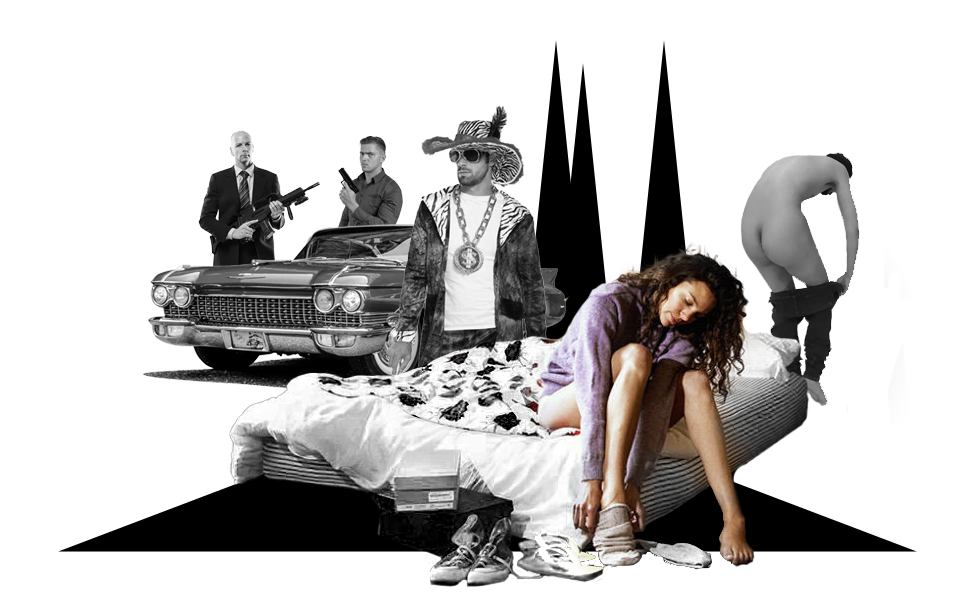
Collage of images illustrating prostitution
Prostitution arises at the intersection between men's demand for sexual acts and women's vulnerability. Those who end up in prostitution do not do so by choice, but carry with them experiences of sexual abuse, poverty, violence, or a lack of alternatives. Research shows that early abuse is one of the strongest risk factors. It creates shame, anxiety, and a feeling of worthlessness, which makes the person particularly vulnerable to new violations.

Many describe an "inner compulsion" – like an inner pimp – that drives them back into environments where they are exposed again. In order to endure, they learn to shut off their feelings and mentally disappear, which is initially a survival strategy but later enables the reality of prostitution. Economic vulnerability reinforces this vulnerability. When you lack security, social support, and alternatives, money can seem like the only way to survive. The image of prostitution as a voluntary side job does not correspond to the reality we encounter.

The consequences are extensive: many suffer from PTSD, depression, self-harming behavior, chronic pain, and recurring violence. For those who are documented in pornography, the damage is often permanent because the material continues to circulate. Sweden's sex purchase law is based on the understanding that prostitution is not a job but a form of sexual exploitation. Therefore, it is the buyer who is criminalized, not the seller. The law has reduced street prostitution and made Sweden less attractive for human trafficking, and has recently been strengthened to also cover certain forms of remote sex purchases. Leaving prostitution is a demanding process that involves regaining dignity, building trust, processing trauma, and creating new conditions for livelihood and community.Talita supports women who want to leave prostitution, pornography, and human trafficking.

Through therapy, practical support, education, and future planning, we help women rebuild their lives. Our conviction is that no human being is a commodity and that every woman has the right to a life of freedom and security.
Collage of images illustrating pornography

Pornography

"Everyone who watches Deep Throat is watching me
ing being raped."

— Linda Lovelace
Pornography is often portrayed as voluntary entertainment between adults, but the reality behind the camera is very similar to prostitution. Many of those involved come from vulnerable backgrounds marked by previous abuse, poverty, mental illness, or dependency.

The consequences can be serious: PTSD, dissociation, chronic pain, and lifelong anxiety about the material being distributed and never being able to be taken back. Despite this, pornography production is not criminalized in Sweden.

Although laws on pimping and human trafficking could be used against porn producers, this is rarely done, and court cases show how difficult it is to prosecute exploitation when pornography is protected as freedom of expression under the constitution.
As long as the content itself is not illegal, the state cannot ban it.

However, this does not mean that exploitation is legal. Coercion, manipulation, and exploitation in production can already be covered by human trafficking or sexual offense legislation, but enforcement is weak. The result is a legal vacuum where producers are rarely held accountable, even though the harm to those involved is often as serious as in prostitution.

After many years of advocacy work, a government inquiry was launched in 2022, which showed that violence and abuse in pornography production is widespread. The inquiry concluded that those who are exploited need support, care, and exit routes—something that has been lacking until now.
Legislation has recently been tightened with regard to remote sex purchases, which means that certain forms of digitally ordered sexual acts can now be subject to criminal liability. However, traditional pornography is still exempt, even though in practice it involves sexual acts being performed for remuneration in front of a camera.

Talita believes that pornography production should be understood as commercial sexual exploitation. Anyone who organizes, films, or makes money from someone else's sexual acts is acting in a pimp-like role. Regulating production would not restrict freedom of expression, but would target the exploitative relationship—not the content.
Sweden has begun to take steps to protect people who are exploited in both prostitution and pornography, but much remains to be done. Only when legislation clearly recognizes pornography production as a risk environment for exploitation can vulnerable individuals receive the protection and justice they need.

Human trafficking

“I’ve been held down like a piece of meat while monsters disguised as men violated me again and again.”

— Gladys Lawson
Blood Borne Connections

A collage of images depicting human trafficking
Human trafficking is often described as modern-day slavery. Although the transatlantic slave trade was abolished 200 years ago, millions of people today live in situations where they are bought, sold, and exploited—often in prostitution.

The driving force is demand: as long as there are men who want to buy sexual services, there will also be a market for recruiting, transporting, and exploiting women and children. Human trafficking is one of the most profitable forms of organized crime, alongside arms and drug trafficking.

Swedish law defines human trafficking as someone recruiting, transporting, housing, or receiving a person for the purpose of exploiting them, using improper means such as violence, threats, deception, or exploitation of vulnerability. It is sufficient that the purpose existed—the exploitation does not need to have been carried out. Any "consent" is irrelevant when improper means have been used. For children, this requirement does not even apply: all trade in children for exploitation is human trafficking, regardless of how it was carried out.

The penalties are severe, but in practice, convictions are rare and sentences are often well below the maximum level. Researchers and authorities point to unclear requirements, narrow interpretation in the courts, and a lack of resources as reasons why many cases never reach a verdict. The number of unreported cases is high; the statistics largely reflect what is detected and prioritized—not the actual extent of the problem.
Behind every case is a chain of vulnerability. Poverty, unemployment, discrimination, lack of education, and violent family relationships increase the risk of being recruited. Many are lured with false job offers, others are exploited through relationships, debt, or threats against their families. Today, the internet is the largest marketplace: women and girls are advertised, bookings are made, and "new" victims are presented to buyers. Control is maintained both through physical violence and through an "inner prison" of fear, guilt, shame, and dependence.

The consequences for those who are exposed are often lifelong: isolation, violence, sexual abuse, torture, drugging, severe trauma, and in the worst cases, death. Those who return home also risk stigmatisation and exclusion, which means that many end up in new situations of exploitation.
Sweden has legislation against human trafficking, but real protection requires more than words in the law: early detection, safe accommodation, exit programmes, secure residence permits for victims of crime and a clear focus on reducing demand.